
Report on Rímur 2026: New Directions in Rímur Research
Málþing á vegum Miðaldastofu Háskóla Íslands — A University of Iceland Centre for Medieval Studies Symposium
Föstudaginn 23. janúar 2026 kl. 14.00-16.30 — Friday, January 23, 2026, at 14.00-16.30
Fyrirlestrasal Eddu (E-103) — Edda auditorium (E-103)
Dagskrá — Programme
- 14.00–14.30 Lena Rohrbach (University of Basel/University of Zürich): Kveða eins og fellur í buccam: Critical Approaches to Rímur in the Eighteenth Century
- 14.30–15.00 Natalie M. Van Deusen (University of Alberta): From Saga to Rímur: The Case of St. Agnes of Rome
- 15.00–15.30 Kaffihlé — Coffee break
- 15.30–16.00 Teresa Dröfn Freysdóttir Njarðvík (Stofnun Árna Magnússonar): The Neverending Story: Kaleidoscopic Narrative Elements and Cultural Memory in Rímur and Rímur-Derived Prose
- 16.00–16.30 Katelin Marit Parsons (University of Iceland/Stofnun Árna Magnússonar): Riches to Rag Paper: Rímur in Manuscript Culture After 1550
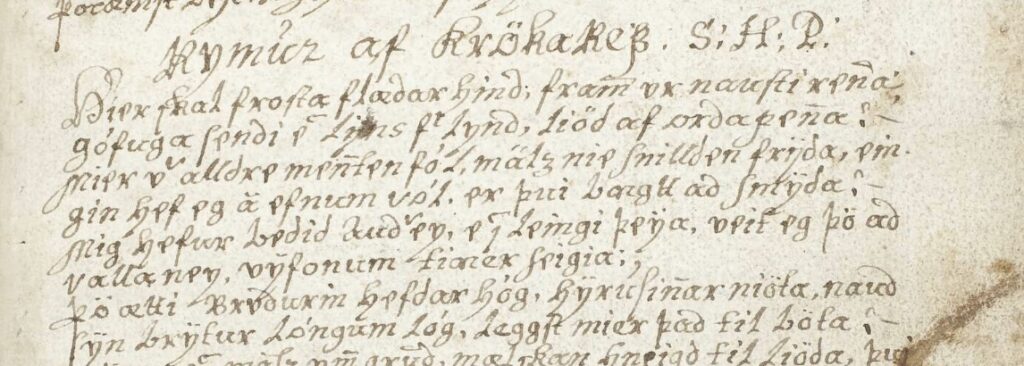
Árið 1955 birti Stefán Einarsson greinargerð um rímnakveðskap, „Report on Rímur“, í bandaríska tímaritinu Journal of English and Germanic Philology (JEGP). Aldarfjórðungi síðar sendi Shaun Hughes frá sér greinargerð um helstu rannsóknir á rímnakveðskap síðan 1955: „Report on Rímur 1980“. Áhugi á rímnakveðskap hefur aukist mikið undanfarin ár eins og sjá má á nýjum rannsóknum, útgáfum og þýðingum sem opnað hafa þetta rannsóknasvið fyrir nýjum og fjölbreyttum hópi nemenda og rannsakenda. Í þessari greinargerð um rímur 2026 — „Report on Rímur 2026“ — verður sagt frá nýjum rannsóknum á rímum og rímnahefð frá ýmsum hliðum, svo sem handritageymd, efnismenningu og miðlun.
In 1955, Stefán Einarsson published the first “Report on Rímur” in the Journal of English and Germanic Philology (JEGP). Twenty-five years later came Shaun Hughes’ “Report on Rímur 1980,” which covered developments in the field after 1955. Recent years have seen a resurgence of interest in rímur, with new studies, editions and translations opening up the field to a wider range of students and researchers than ever before. Our “Report on Rímur 2026” showcases recent work on rímur and rímur traditions in their material, medial and academic context. See abstracts below.
Fundarstjóri / Chair: Brynja Þorgeirsdóttir
Kvæðamaður: Þorsteinn Björnsson
Málþingið verður haldið á ensku og er öllum opið. / The symposium will be held in English and is open to all.
Miðaldastofa Háskóla Íslands — The University of Iceland Centre for Medieval Studies
—o—o—o—
Lena Rohrbach
Kveða eins og fellur í buccam
Critical Approaches to Rímur in the Eighteenth Century

The first half of the eighteenth century is the time in which the Arnamagnæan manuscript collection was organized in its final shape following Árni Magnússon’s death in 1730. It is also the period during which the first attempts at histories of Icelandic literature were composed. This paper will approach both these developments with regard to what they reflect about learned approaches to rímur in this first period of Old Norse scholarship.
The placement and categorization of manuscripts containing rímur in the manuscript collection as can be discerned from the first catalogue of the collection by Jón Ólafsson úr Grunnavík and comments on individual manuscripts give insights into conceptualizations of rímur within the overall corpus of texts. The literary histories offer more expansive views of the status and character of this poetic tradition, with considerations of a general kind on the contents, language, metrics, style and (lack of) virtuosity of these poems in relation to both medieval and other contemporary poetic texts, as well as assessments of individual poems.
These early categorizations, definitions and evaluations of rímur both in the organization of the Arnamagnæan archive and in the early literary-historical writings are not only testimonies to the development of Old Norse scholarship at a specific moment in time, but have profoundly influenced and shaped later approaches to this part of Icelandic literary history over the centuries.
Lena Rohrbach is Professor of Scandinavian Studies at the Universities of Basel and Zürich. Her research focuses on late medieval and early modern Icelandic literary traditions in their material and medial context and on premodern critical approaches to this tradition.
—o—o—o—
Natalie M. Van Deusen
From Saga to Rímur
The Case of St. Agnes of Rome

The legend of St. Agnes, the thirteen-year-old Christian virgin who was martyred in Rome in ca. 303–304 CE, survives in three Old Norse prose redactions, all of which are translations of the Pseudo-Ambrosian Passio Agnetis. Agnes was the co-patron of two churches in medieval Iceland, and hers was a Holy Day of Obligation during the country’s Catholic period; her prose legend, like those of the other virgin martyrs, seems to have been especially popular among women in religious orders, for whom the legends of virgins probably had their largest audience. There are also several poetic renderings of the legend of St. Agnes in Iceland, from both the Middle Ages and the Early Modern period. One of these is a rímnaflokkur, Agnesarrímur, composed in the seventeenth century by Rev. Eiríkur Hallsson í Höfða (1614–1698) for his friend’s young daughter, Hólmfríður Benediktsdóttir; the rímur in four fits are extant in only one manuscript (Lbs 705 4to, ca. 1825–34), but are important, both because they represent a larger trend in adapting the stories of saints and other holy women to rímur but also because they likely were the source for the highly popular Agnesarkvæði, allegedly composed ca. 1725 by Þorvaldur Magnússon and extant in over one hundred manuscripts and audio recordings.
This paper provides an overview of Agnesarrímur and its adaptation of Agnes’ vita and passio. It focuses especially on the relationship between Eiríkur’s rímur and the three extant redactions of Agnesar saga. It also considers the other Latin and vernacular works named in the rímur, on which Eiríkur drew when composing his work. The paper considers when, where, and in what form Eiríkur would have had access to these sources, which by extension lends important insight into the availability of Latin texts and works translated from Latin in early modern Iceland. The paper concludes with a consideration of how the sources Eiríkur consulted for his rímur are reflected – or not – in Þorvaldur Magnússon’s Agnesarkvæði, which became the rímur’s greatest measurable legacy.
Natalie M. Van Deusen is a Professor at the University of Alberta. Her area of research specialization is Old Norse and early modern Icelandic paleography and philology, hagiography, and religious literature, with a focus on women, gender, and disability. She has published several books and numerous book chapters and journal articles related to these topics.
—o—o—o—
Teresa Dröfn Freysdóttir Njarðvík
The Neverending Story
Kaleidoscopic Narrative Elements and Cultural Memory in Rímur and Rímur-Derived Prose
The aim of this paper is to shed light on kaleidoscopic narration within the Icelandic rímur tradition and the rímur-derived prose in post-medieval Icelandic literature. Discussing how kaleidoscopic narration manifests within the tradition and pointing out how it can also be seen as an integral part of the tradition itself. It is an established opinion that rímur are usually based on pre-existing narratives, often already recorded in prose form. Most commonly narratives based in legendary sagas, chivalric sagas, king’s sagas and Íslendingasögur were transformed into a rímur composition. In a few cases no prose narratives are preserved pre-dating the rímur composition, suggesting that they are based on now lost narratives. In later rímur, the tradition is expanded and rímur are composed based on material within oral tradition, eddic poetry or other types of narrative poetic forms.
The rímur form itself suggests a kaleidoscopic narrative element – where a narrative in prose form is recast into a poetic form. However, the narrative within the rímur is not slavishly bound to its prose narrative precursor. The rímur narrative might contain a change of emphasis, additional narrative plots, play on generic traits or boundaries or in other ways makes use of the narrative material at hand in an innovative way. These changes within the rímur tradition have even at times resulted in a new prose redaction of the narrative material – even in cases where older prose narratives are preserved. This suggests a certain fluidity within the literary tradition, where narratives flow freely between literary forms, adapting or adding narrative elements all along the way.
Teresa Dröfn Freysdóttir Njarðvík holds a PhD in Icelandic Literature from the University of Iceland and is currently a researcher at the Árni Magnússon Institute for Icelandic Studies, where she is part of the research project “Riches to Rags: The Popularisation of Rímur Poetry in Post-Medieval Iceland.”
—o—o—o—
Katelin Marit Parsons
Riches to Rag Paper
Rímur in Manuscript Culture After 1550

The introduction of rag paper in Icelandic manuscript culture had a transformative impact on poets’ ability to gain access to copies of other poets’ work and to disseminate their own compositions in written form. While premodern rímur are associated with strong performance traditions, late medieval rímur manuscripts seem to have been mainly produced for elite patrons in northwestern Iceland. The publication of the Vísnabók [Book of Verses] at Hólar in 1612 marks a milestone in the development of rímur as a form of popular poetry: for the first time, mass-produced printed books containing rímur became available to households around the island. Prior to this, most Icelanders’ exposure to rímur would have been through encounters with rímur performance.
In my talk, I will introduce the project “Riches to Rags: The Popularisation of Rímur Poetry in Post-medieval Iceland” (Project Leader: Margrét Eggertsdóttir), funded by the Icelandic Research Council (grant no. 2511601-051). Among the project goals is the development of a database of rímur poets active during the period from approximately 1550 to 1725, surviving rímur and associated manuscripts. Building on the extensive work of Finnur Sigmundsson on premodern rímur and rímur poets, we hope to demonstrate the versatility of rímur as a poetic form after 1600 and the increasingly prominent presence of rímur in non-elite manuscript culture.
Katelin Marit Parsons is a co-PI on the project “Riches to Rags: The Popularisation of Rímur Poetry in Post-medieval Iceland” (2025–2028) at the Árni Magnússon Institute for Icelandic Studies and an adjunct lecturer at the University of Iceland. She holds a PhD in Icelandic Literature from the University of Iceland.
Miðaldastofa Háskóla Íslands — The University of Iceland Centre for Medieval Studies
—o—o—o—